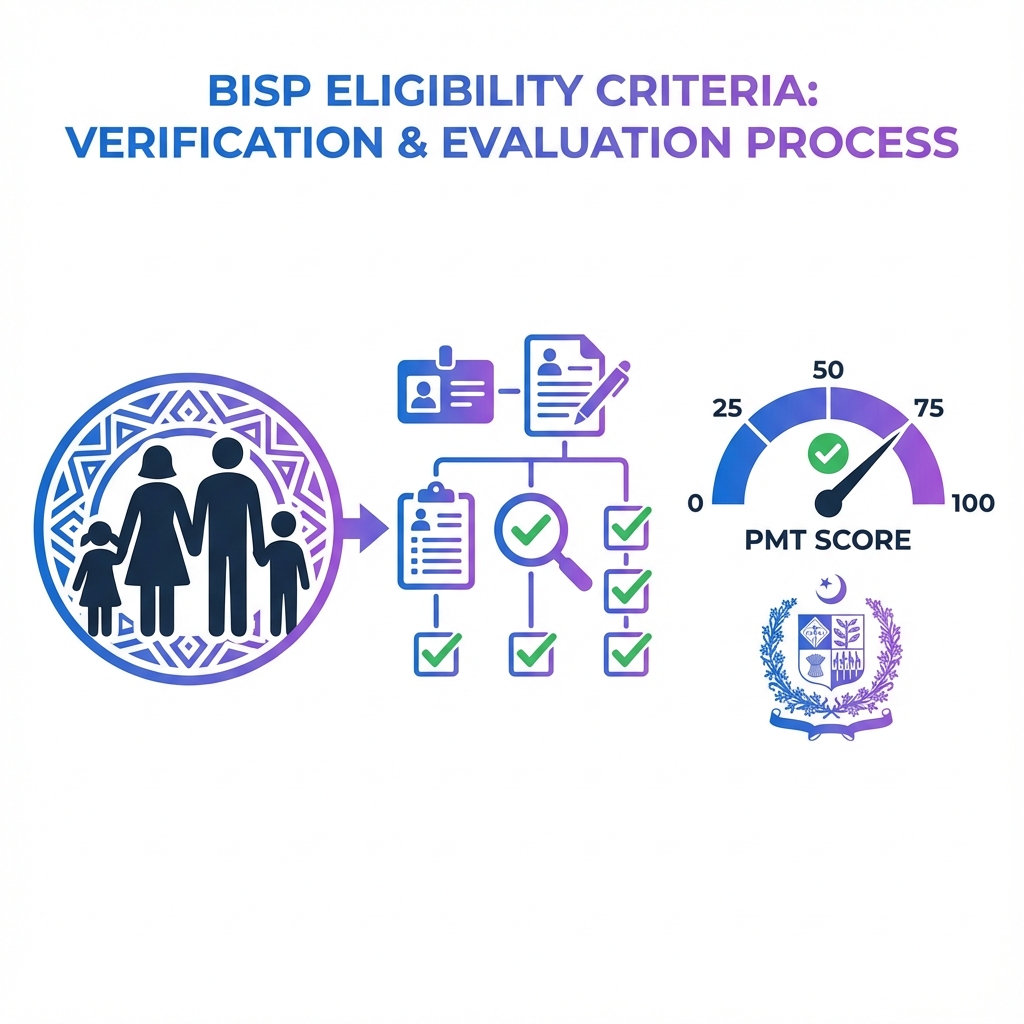
BISP uses the National Socio-Economic Registry (NSER) and a Proxy Means Test (PMT) to decide who qualifies for cash support under Benazir Kafaalat. The PMT score runs from 0 to 100, and BISP sets a cut-off score to identify poor households.
The 8171 portal is the public screen where a person checks household eligibility by CNIC.
What "eligible" means on 8171
"Eligible" means the household meets the programme rules stored in the NSER record, mainly the PMT cut-off and identity requirements. For Benazir Kafaalat, the Economic Survey describes eligibility as PMT-based, with a defined cut-off score.
A household may qualify for one support type and fail another. The 8171 result reflects the rule set tied to that specific benefit cycle.
Core eligibility rules used by BISP
1) PMT score cut-off
Pakistan's Economic Survey 2024–25 states that eligibility for BISP's flagship unconditional cash transfer (Kafaalat) uses PMT, with a cut-off currently set at 32, and 37 for families with disabled members.
A PMT score of 0-100 measures poverty level. Lower scores = higher poverty. You need a score at or below 32 (or 37 for disabled member households) to qualify.
2) Target group in the household
The same Economic Survey notes that BISP's unconditional cash transfer was previously for ever-married women, and the scope expanded to include transgender persons under a stated transgender policy.
A Senate record on Benazir Kafaalat describes eligible beneficiaries as ever-married women of households under the PMT cut-off of 32.
3) NSER record and survey status
The Economic Survey reports large scale re-survey and new registrations through the Dynamic NSER, which shows that the registry works as the base for eligibility decisions and can change after a fresh survey.
4) Identity and verification requirements
The Economic Survey describes a biometric regime inside the Dynamic NSER process to protect data access and strengthen verification, which signals that identity proof is part of the eligibility pipeline, not a side task.
PMT thresholds at a glance
This table lists the PMT cut-offs and related ranges that appear in official government reporting, so readers can match their household situation with the rule that applies.
| Case | PMT rule in government reporting | What it means for eligibility |
|---|---|---|
| Standard Benazir Kafaalat eligibility | PMT cut-off set at 32 | Households at or below the cut-off qualify for Kafaalat review and selection. |
| Household with disabled member | PMT cut-off set at 37 | A higher cut-off applies for families with disabled members. |
| Other schemes that use broader PMT ranges | Example range 0–40 for a pilot savings scheme in the Economic Survey | Some social protection schemes use wider PMT ranges than Kafaalat. |
Special inclusion noted in government reporting
Transgender inclusion
Pakistan's Economic Survey 2024–25 states that BISP expanded Kafaalat coverage to include transgender persons, tied to CNIC gender status and a mandatory survey, and it notes relaxed PMT cut-off restrictions for this group.
Families below PMT 32 in relief targeting
The Economic Survey describes Ramadan 2025 relief for families below PMT 32, which reinforces PMT 32 as a central threshold used in targeting.
Who is not eligible
Government material published through the National Assembly question record shows a blocked criterion for government employee status.
BISP material about NSER notes that the programme uses exclusion filters, and it gives examples such as vehicle ownership and frequent air travel.
- Government employee in household
- Vehicle ownership
- Frequent air travel
- PMT score above cut-off threshold
How to check eligibility through 8171
To check eligibility through 8171, enter the CNIC on the official 8171 portal page and submit the code shown on screen to view the household result.
Why an eligible household later shows "not eligible"
These are the most common rule-based causes, based on how the system is described in government reporting:
- A new dynamic survey changes household data, which changes the PMT outcome.
- A household falls above the PMT cut-off, so the system stops Kafaalat eligibility under the stated threshold.
- An exclusion filter matches the household record, such as the examples listed in NSER notes.
Old rule, old wisdom: when money is tight, the record must be clean. The system does not argue, it just rejects.